



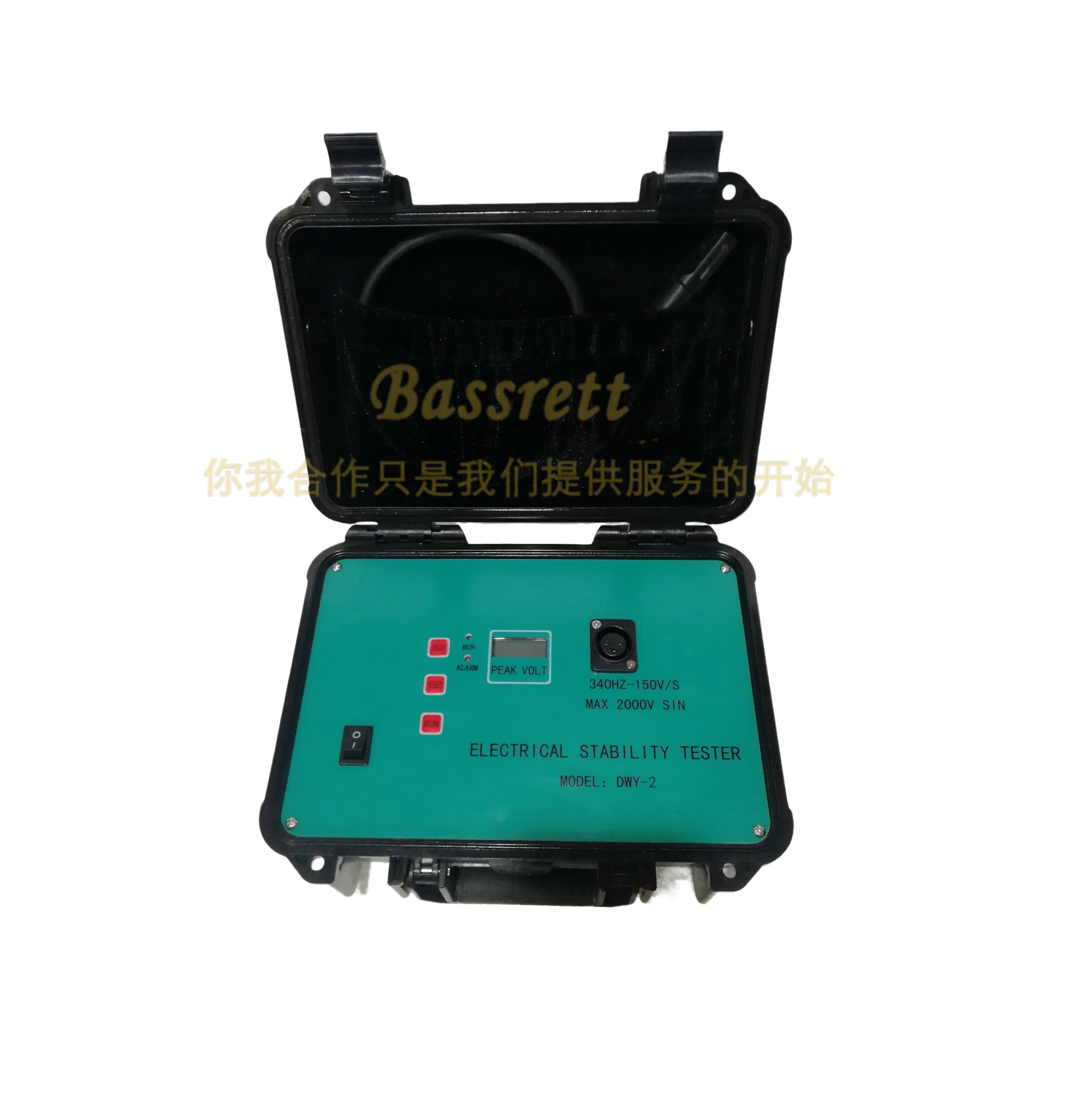
一、Overview
The DWY-2 electrical stability tester is a sine wave instrument manufactured in accordance with the National Petroleum Institute (API) "Recommended Practice Standard Procedure for Field Testing of Oil-based Drilling Fluid" 13B-2. It is precise, concise and portable. It is used in conventional sites and laboratories to measure the relative electrical strength of drilling fluids with continuous oil phases. The DWY-2 tester is composed of a test instrument and a probe. It is powered by four common 9-volt alkaline batteries. The dielectric breakdown voltage is the key to the conductivity of the drilling fluid. The DC power supply of the battery provides an AC voltage to the electrode at a low frequency.
The size of the electrical stability tester, the spacing between the electrodes and the current have been standardized. The two electrodes are the same size, with a spacing of 0.061 inches; the current size is set to 61uA, the continuously increasing voltage, its frequency is fixed at 340 ±10Hz, and the continuously increasing amplitude sine wave has been loaded on the electrode. The electrode is immersed in the drilling fluid. If the current between the electrodes begins to conduct and increases to 61uA, the voltage will automatically stop growing and the peak voltage reading will stabilize. At this time, the peak voltage will be recorded and the breakdown voltage of the dielectric will be displayed.
The electrical stability value will decrease as the test temperature increases, and the recommended API test temperature is 120± 5℉ (49± 3℃). The shearing process of chemical composition and drilling fluid controls the absolute value of DWY-2.
Because DWY-2, a petroleum-based drilling fluid, is complex and changeable, the conditions that affect the electrical stability of the drilling fluid are mainly: (1) The continuity of resistivity (usually refers to heavy oil) (2) Non-continuity of conductivity (usually water droplets and dissolved salts) (3) Solid particles with suspended properties (4) Temperature (5) The size of the droplet (6) Different types of emulsifiers (7) Dielectric properties of liquids (8) Shearness of the sample Therefore, explaining its oil and wet state from the results of the first electrical stability test does not represent the performance of the drilling fluid.
Because many factors affect the measurement, the absolute value of a measurement is not absolutely meaningful. It is recommended to test several times and build a trend chart with multiple measurement results. This trend chart can accurately reflect the properties of drilling fluid and provide a basis for drilling fluid treatment.
二、Model and specification
DWY-2
三、Main technical parameters
The electrical stability tester is driven by a battery and is a portable instrument that conforms to the electrical stability test process of the API 13B-2 specification.
The components of the instrument include a test unit, an electrode probe, two calibration blocks, a power cord and four batteries.
- Operating temperature range 0-50℃ (32-122℉)
- The maximum test temperature of the probe is 120 ± 5℉(49 ± 3℃)
- Storage temperature range -20--70℃ (-4--158℉) (no battery)
- Accuracy ±2% of the expected value
- Automatic power-off time 1 minute
- Output frequency 340±2Hz
- Output waveform sine wave
- Output voltage range 0-2025V±25V (effective value 1432V)
- Milk breaking current 61 μA
- Voltage display Digital liquid crystal display
- Voltage rise rate 150±10V/s
- Power supply 4 9V alkaline batteries
- The service life of the battery can be tested about 260 times.
- The length of the probe and cable is 85cm (3.35in)
- Probe electrode spacing 0.155cm (0.061in)